
How many Kama Sutra position names are there?
There is not one universally accepted final number. The safest answer is to explain how the chapter is counted rather than repeating a random viral total.
Kamasutra guide
Written by: Kamasutra Cute Editorial Team · Reference glossary and source-comparison editorial work
Reviewed: Reviewed against cited translation and encyclopedia sources
Updated: June 2, 2026
Kama Sutra position names and descriptions are harder to learn than most internet lists make them seem. Some pages recycle a tiny list of eight names, some insist there are 64, and others mix classical names, modern labels, and poster-friendly nicknames as if they all came from the same source.
Short answer: the classical text does not give one neat internet-style final number, and the names people repeat online are often coming from different counting systems. This page works as a reference-first glossary for couples: what the defensible classical names are, why counts vary, how descriptions change across translations, and when a modern label is just a modern label rather than the original name.
If you want the broadest practical guide to positions, use the couples hub. If you want names, labels, and descriptions, this is the page that should own that intent.
Reference note
Need the meaning first?Use the meaning page for the literal translation and historical context. Stay here when your question is specifically about names, labels, counts, and descriptions.

Quick glossary
What this page owns
Position names, labels, and descriptions for couples.
Classical focus
Named forms discussed around Burton Part II Chapter 6.
Why counts vary
Different pages count grouped forms and later varieties differently.
Classical vs modern
Classical names are not always the same as modern poster or blog labels.
Name groups on this page
Top questions
There is not one universally accepted final number. The safest answer is to explain how the chapter is counted rather than repeating a random viral total.
Because translations, summaries, and modern labels often compress or rename the original material for convenience.
Learn the shape and support pattern first, then treat the name as a helpful reference label rather than the whole lesson.
Section 1
A good page should answer the reader's first confusion immediately: why do some sites mention only eight names? Usually because they are not trying to map the chapter carefully. They are pulling out a handful of the most repeatable names, trimming away grouped forms, and ignoring the later animal-style series. In other words, the number is often a packaging choice, not a faithful count.
That is why there is no single universally accepted final total of Kama Sutra position names online. Some modern pages count only a few famous examples. Some count every named form in Burton's Chapter 6. Some also count the later animal-style congresses one by one. Others quietly import material from later manuals and still label everything "the Kama Sutra."
So the honest answer is not simply "8" and not automatically "64." A careful reading of Chapter 6 gives you roughly 19 named forms before the later grouped and imitative series are counted separately.
Section 2
If you are new to this topic, this trio is the right place to start because it shows that Chapter 6 is not just throwing out random exotic names. It opens with three early forms: the widely opened position, the yawning position, and the position of Indrani. The yawning form is often linked to the Sanskrit jrimbhitaka, which carries the sense of opening or widening. Indrani is the most distinctive of the three because it is tied to the wife of Indra and is treated as a more advanced, more demanding arrangement.
These three matter because they show the chapter's logic early. The names are paying attention to opening, angle, bodily arrangement, and difficulty, not just trying to sound memorable. That is one reason a serious glossary feels different from a listicle.
Section 3

The clasping position is one of the clearest classical names and is often connected with samputaka. The basic idea is enclosure: bodies coming together in a close, compact embrace. That is why English translators often reach for words like clasping, box-like, or enclosed.
For a modern reader, the important point is that this is not just a decorative Sanskrit word. It reflects a specific logic of contact. The name tells you how the bodies relate to each other. That is exactly the sort of thing many modern listicles erase when they turn everything into novelty pose names with no explanation.
Section 4
This is where modern lists often get sloppy. Chapter 6 does not give you only one "pressed" idea. It moves through pressing position, then later pressed position and half-pressed position. In translation these names sound repetitive, but that does not mean they are redundant. They signal closer pressure, different leg arrangements, and modified degrees of compression.
The Sanskrit piditaka is commonly associated with the pressing idea, but it is better to treat the whole cluster as a pressing family than to pretend every English label maps neatly to one universally agreed Sanskrit term.
Section 5
The twining position is one of the most memorable classical names because the image is so clear: limbs winding, wrapping, or entwining around each other. This is why it is often linked to veshtitaka, a term associated with envelopment or wrapping.
What makes this name useful is that it still teaches something even in translation. You do not need a fake mystical explanation to understand it. The name itself tells you that the form is about interlocking contact, not brute novelty. That is also why twining survives so easily in modern glossaries and illustrated guides.
Section 6

The mare's position matters because it reminds readers that not every named form in Chapter 6 is a neat static pose. This one is often linked to vadavaka and is usually explained as a matter of muscular control, especially gripping action, rather than just where the legs go.
That is a useful corrective to shallow modern summaries. Some classical names refer to technique or bodily action, not only to a freeze-frame silhouette. If you miss that distinction, you miss part of what makes the chapter different from a modern poster or app that reduces everything to easy visual slots.
Section 7

The rising position shifts emphasis toward lift and angle. Instead of just saying two bodies come together, the name points to elevation. One part of the body rises, which changes the geometry of the union and creates a distinct form worth naming separately.
This is exactly the kind of detail competitors often flatten. They either skip the name entirely or rename it as something more marketable. But the original logic is simple and useful: Chapter 6 is watching for changes in bodily arrangement closely enough that even a change in elevation becomes a named form.
Section 8

Few names show the Kama Sutra's metaphor style more clearly than splitting of a bamboo. The image is asymmetry. One leg or side is lifted and separated in a way that makes the body resemble a stalk being opened or parted.
This is one reason the text is interesting even before you think about trying anything. The names are not random. They are visual teaching tools. Bamboo gives the reader a quick picture of shape and direction. Modern content that strips out the metaphor and replaces it with a generic "advanced leg-up pose" loses the whole point of the original naming system.
Section 9
Fixing of a nail and crab's position are a good pair to read together because both show how concrete the imagery can get. "Fixing of a nail" suggests an anchored or planted limb. "Crab's position" suggests a more compact, bent, gathered arrangement that makes the comparison immediately visual.
When a page only throws these names into a list, the reader learns almost nothing. The better way to present them is to explain that Chapter 6 often names forms by the shape the body makes or by the action one limb performs. That is what turns the list into a real glossary instead of trivia.
Section 10
A lot of modern articles treat packed position, lotus-like position, and turning position as if they were interchangeable "fancy" names. They are not. Packed suggests compression or gathering. Lotus-like suggests a more crossed, compact, petal-like arrangement. Turning suggests rotation or reorientation.
Grouped together, these names show something important about the chapter: it is exploring variation inside closeness, not just bigger and more dramatic extremes. That is one reason a serious reader gets more value from the original naming logic than from endless modern "best positions" slideshows.
Section 11

By the time the chapter reaches supported congress and suspended congress, it has clearly moved beyond the simplest lying-down forms. These names matter because they show that the text is willing to classify forms by support structure. A body can be supported, lifted, braced, or held, and that change is significant enough to become its own named type.
This is also where many modern summaries quietly stop being careful. They either skip these forms or rewrite them in a sensational tone. A better explanation is simpler: the chapter is tracking how support changes the kind of union.
Section 12

Congress of a cow is important because it sits at the edge between the main named forms and the later animal-style naming habit. On one hand, it appears clearly enough to be discussed as its own named form. On the other, it prepares the reader for the longer imitative series that follows.
That makes it a hinge point in the chapter. If you only read modern listicles, you miss that transition. A good glossary should show that the text is moving from more conventional positional names toward a different naming logic based on imitation and analogy.
Section 13

After the core named forms, the chapter also mentions congresses like those of dogs, goats, deer, asses, cats, tigers, elephants, boars, and horses. This is one reason online counts explode so quickly. Some writers treat each animal comparison as a separate named "position." Others treat them as a later imitative cluster rather than part of the main list.
That is why a strong page should mention them clearly without pretending they function exactly like the earlier names. They belong to the text, but they are not doing exactly the same job as samputaka, jrimbhitaka, or the splitting of a bamboo.
Section 14
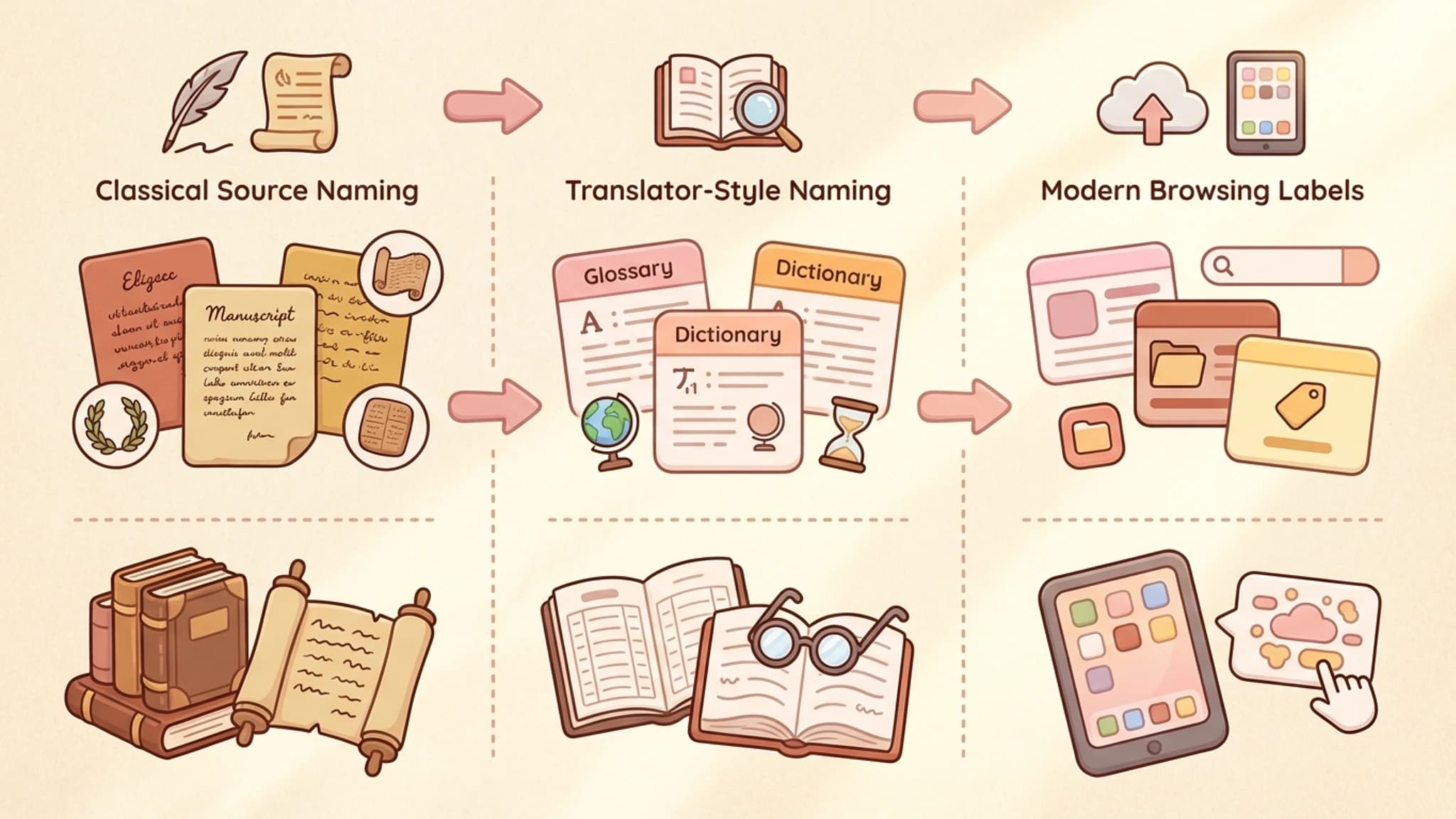
This is the part beginners almost never get explained. Modern lists mix classical names, Burton-style English translations, friendlier contemporary labels, and completely new marketing names as if they all came from the same source. They did not.
A practical reader should ask three questions every time. Is this a name the chapter itself gives? Is it a translator's English rendering? Or is it a newer label invented to make the idea easier to browse? Our own couples and beginner guides use friendlier labels for navigation, but the point should be clarity, not pretending every modern label is ancient. Once you understand that distinction, the whole subject becomes much easier to read without getting misled.
Closing Note
The most useful way to learn Kama Sutra position names and descriptions is to stop expecting one perfect internet list and start separating classical names, translation choices, and modern labels. Once you do that, the subject gets clearer fast.
Use this page when you want naming clarity. Use the main couples guide when you want a broader list of positions to try. Use the beginners guide when you want the easiest first shapes instead of the biggest glossary.
Common Questions
Because they are summarizing, not counting carefully. They usually pick a few memorable examples, skip grouped forms, and package the topic into a short list that is easier to share than a proper glossary.
There is no single final internet-friendly number. If you focus on the named forms in Burton's Part II Chapter 6, you get about 19 named forms before later grouped and animal-style varieties are counted separately. Modern lists often count differently.
No. A modern article might use an easier English label, a poster nickname, or a blended description that helps couples remember the shape. That can be useful, but it is not the same as saying the classical text used that exact name.
Use this page for names, labels, and descriptions. Then move to the couples hub for broader practical guidance, or the beginners guide if you want the easiest first poses.
References
Keep Reading
Jump into a few softer picks first, or skip straight to the hotter side of the archive.
Date Ideas
Shop The Mood
You've seen the guide. Here are a few pieces that make the whole thing feel more real.


